Authorship and responsibility
Dmitry Vaneev — author of the work shown here
Founder of Time into Form. PROOF collects his projects and engineering evidence. Each case states his role, verified results and limitations separately.
20+years of the founder’s software experience
These projects document Dmitry’s own practice, including work before the atelier. This experience belongs to the author; it does not describe the atelier’s age.
Experience does not make a decision correct by default. It helps reveal material risk earlier, distinguish it from unnecessary complexity, and then prove the choice through an operating result.
A product customers understand and choose
I bring the commercial goal into the product from the start: who needs it, why they would choose it, and how they will discover it. Marketing connects the offer, interface, and promotion into one customer journey.
Audience and offer
I examine customer needs, alternatives, and objections. I help define the product’s value and explain it through structure, copy, and examples.
The path to an enquiry or purchase
I design the journey from first contact to the intended action: content, evidence, a clear next step, and events that make the funnel measurable.
Promotion and feedback
I use AI to prepare content, offer variations, and email sequences. I connect promotion with analytics and feedback so hypotheses can be tested and the product improved.
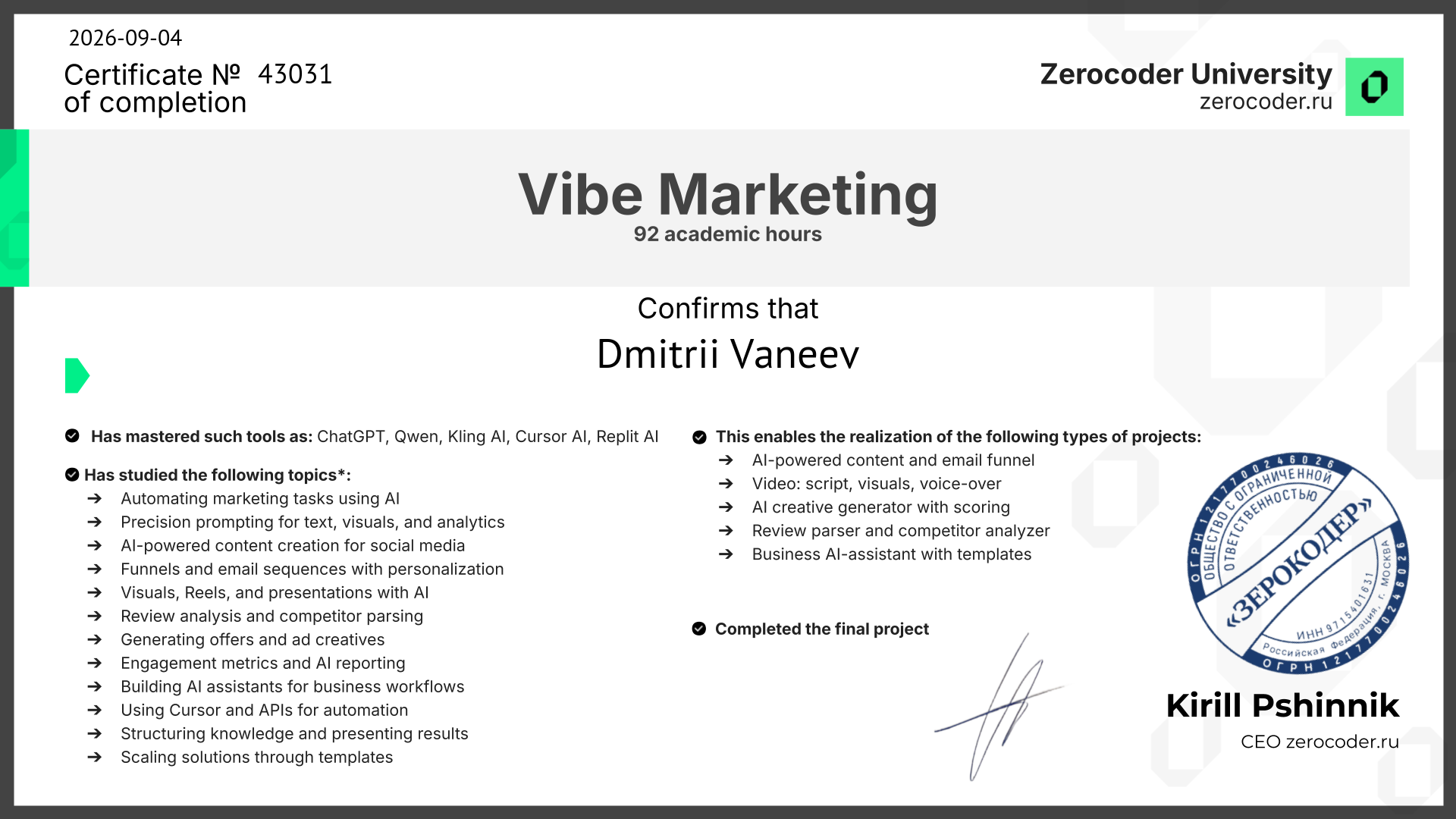
Zerocoder University
Vibe Marketing
92 academic hours · № 43031
Training in AI-assisted marketing: competitor analysis, offers, content, sales funnels, email sequences, and analytics. The certificate confirms completion of the course and its final project.
View the original certificateHow practice changes my decisions
This is not a résumé timeline. It includes only the experience that directly changes how I design a product.
Operating owned systems
Release, monitoring, and recovery are designed before launch, not after the first failure.
Running companies and production
I study the real process, ownership, and human constraints before designing the interface.
Physical engineering
Failure modes, tolerances, and verifiability become part of the design rather than a late addition.
Building businesses and products
Cost, adoption, and ongoing operation are considered alongside technical quality.
AI-assisted work
AI accelerates research and implementation, while verification, architecture, and responsibility remain mine.
Operating products are stronger than a biography
The useful next step is not another list of achievements, but the tasks, decisions, and public verification boundaries of real projects.
View the real projects